
Categories
Helpful TipsPublished April 21, 2026
Building a Better Galt

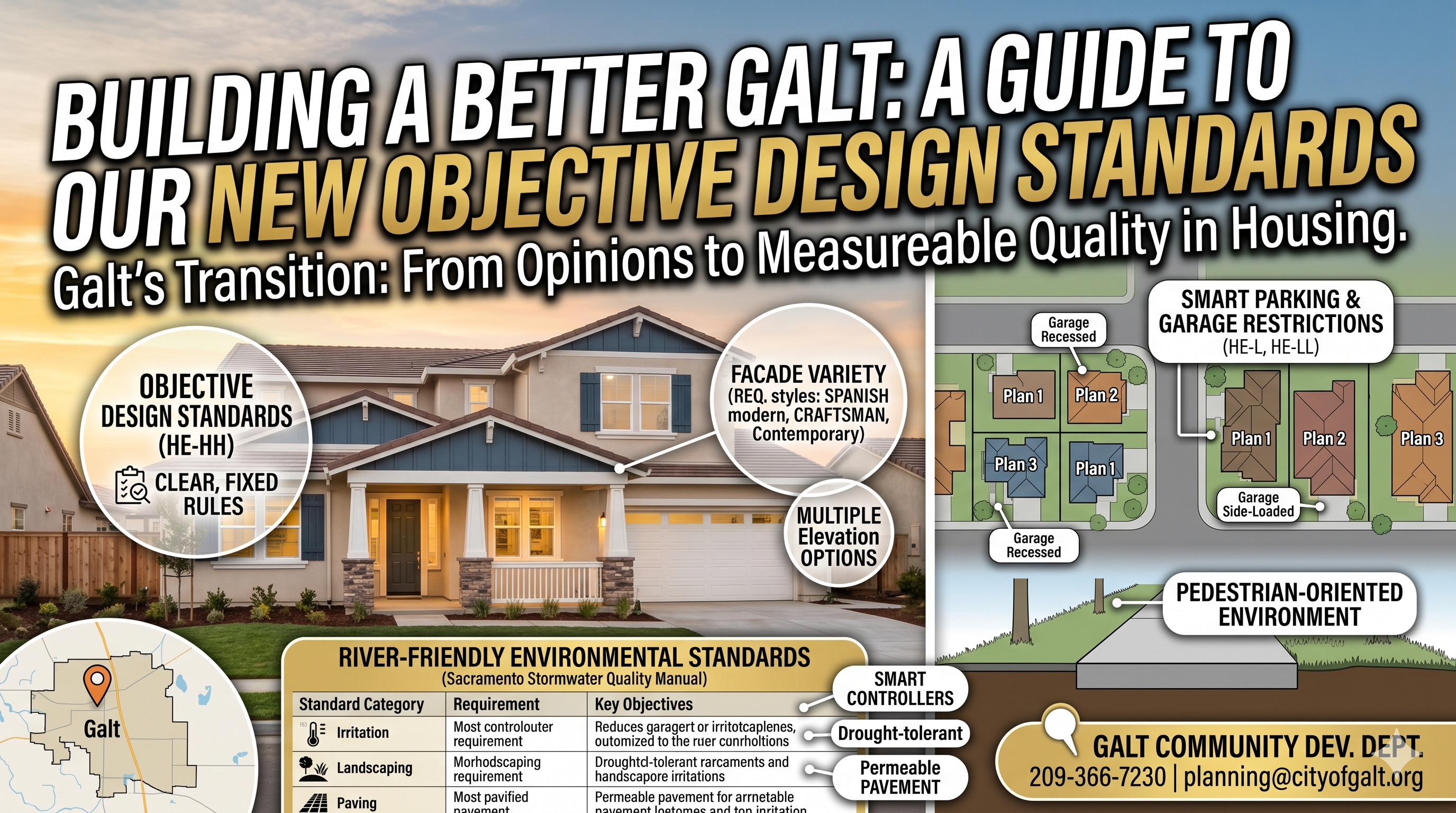
Building a Better Galt: A Guide to Our New Objective Design Standards
1. Introduction: A New Era for Galt’s Neighborhoods
Have you ever wondered how we keep Galt looking like Galt? As our city grows, we want to ensure that new neighborhoods feel like a natural extension of our community, not a generic subdivision found in any other ZIP code. To do this, the City of Galt is transitioning to "Objective Design Standards" for all new residential architecture.
What does this mean for you? As outlined in our Housing Element Implementation Program HE-HH, we are moving away from subjective "opinions" and toward clear, measurable, and fixed rules. Instead of a developer guessing what a committee might like, we provide a "rulebook" of high-quality standards that must be met. This shift allows Galt to comply with new state laws like SB 35 and SB 330, which require a faster, "ministerial" approval process, while ensuring that the City maintains absolute control over the quality and character of every new home built.
2. The "Why" Behind the Shift: Beyond the Cookie-Cutter
In the past, the city used "discretionary reviews," where designs were evaluated case-by-case. While this offered flexibility, it often lacked certainty. By establishing Objective Design Standards, we are actually protecting our residents from "cookie-cutter" developments.
By making variety a legal requirement for a developer to get their permit, we ensure our streetscapes remain vibrant and diverse. This approach supports our commitment to "Innovative Approaches to Housing Development" (Policy HE-1.4) and helps us meet our goal of providing a wide range of housing types for all residents (Goal HE-1). Streamlining our "Permitting Process Review" (HE-II) and removing administrative barriers (HE-6.1) doesn't mean we are lowering our guard; it means we are locking in high standards from day one so that every project contributes to Galt's unique charm.
3. Facade Variety: Creating Visual Interest
Galt’s new standards require developers to provide significant architectural variety. We don’t want a street where every house looks the same. Using the Fairway Oaks Design Review and Elliott Ranch projects as blueprints, the City now expects a diverse palette of "Elevation Options."
Developers are now required to offer specific architectural styles, such as:
- Spanish Modern
- Craftsman
- Contemporary
To prevent repetition, projects must offer multiple floor plans paired with these styles. For instance, in the Fairway Oaks development, the "Cypress" line features 12 distinct design options (four floor plans across three elevations), while the "Ironwood" line offers nine options. This level of variety ensures that no two adjacent houses are identical, fostering a neighborhood that feels custom-built rather than mass-produced.
4. The Fine Print: Roofs, Windows, and Detailing
Our design reviews have moved from "negotiable" suggestions to strict requirements for "Project Architecture." We look closely at exterior materials, rooflines, and window treatments to ensure they meet our community's aesthetic baseline.
You can see these standards in action in recent applications like Summerfield at Twin Cities and Caterina Estates. For example, the Summerfield project introduced the "Cedar Glen" and "Cedar Grove" product lines. By requiring specific detailing for these lines—ranging from 2,018 to 3,306 square feet—the City ensures that even "streamlined" projects (under HE-HH) maintain high-quality aesthetics. These details are no longer up for debate; if a developer wants their permit, the quality must be built into the plans from the start.
5. Smart Parking and Garage Restrictions
We believe our streets should be for people, not just cars. Our new standards place a high priority on "Pedestrian-Oriented Environments" (Program HE-L). This means we are modifying traditional parking standards (Program HE-LL) to reduce the visual impact of garages.
What does this look like in your neighborhood? It means encouraging "smart" layouts where garages are recessed or side-loaded. This prevents the "snout house" effect, where a massive garage door dominates the front of a home. Instead, our standards prioritize front porches and entryways, creating a more welcoming, walkable environment for everyone.
6. Neighborhood Harmony: Two-Story Compatibility
A major concern for many residents is how new two-story homes fit in alongside established single-story houses. To maintain "Neighborhood Harmony," the City now enforces a specific mix of home heights in new subdivisions to ensure they serve everyone from growing families to seniors (Policy HE-3.4).
Recent data from Elliott Ranch Unit 2 and Tim Lewis Communities shows exactly how we enforce this balance:
- Elliott Ranch Unit 2 (R2 Portion): The City required a strict mix where Plans 1 and 2 are dedicated 1-story models (ranging from 1,609 to 2,760 sq. ft.), while Plans 3 and 4 provide 2-story options.
- Tim Lewis (Liberty Ranch): In Villages 3 and 4, the City ensured that while larger 2-story models are available, Plan 2 remains a substantial 2,903 sq. ft. 1-story option.
By mandating this mix, we ensure that new developments offer "single-level living" options that are compatible with the scale of our existing neighborhoods.
7. Integrating Environmental Standards
Galt’s architectural beauty is matched by our commitment to environmental health. Our standards work alongside the Sacramento Stormwater Quality Design Manual to protect our local waterways.
The following "Quick-Reference" table highlights the "River-Friendly" standards that are now a mandatory part of our site designs:
| Standard Category |
Key Objective Requirement |
| Irrigation |
Must use "Smart" controllers that adjust for weather and soil moisture to prevent runoff (Fact Sheet EI-1). |
| Landscaping |
Minimize lawns; prioritize drought-tolerant California and native plant varieties (River-Friendly Landscaping Principles). |
| Paving |
Portland cement concrete is required in fueling, dispensing, and loading zones. Asphalt is prohibited in these high-spill risk areas to prevent chemical leaching (Table FA-1). |
8. Conclusion: The Future of Galt
These objective standards are the tools we use to build a Galt that is inclusive (Goal HE-5) and fair to every neighborhood (Goal HE-7). By making the rules clear, we ensure that every new brick laid and every tree planted contributes to a city we can all be proud of.
We invite you to see these standards in action by visiting the Community Development Department website to view our latest Development Project Lists.
Contact Information: City of Galt Community Development Department Planning Division 495 Industrial Drive, Galt, CA 95632 Phone: 209-366-7230 Email: planning@cityofgalt.org

Brian Halstead
| The Halstead Team | Konrad RE | PLACE
or another way