
Categories
Lodi NeighborhoodsPublished June 5, 2026
Lodi’s Downtown Renaissance: Bridging the Tracks for a Unified Future

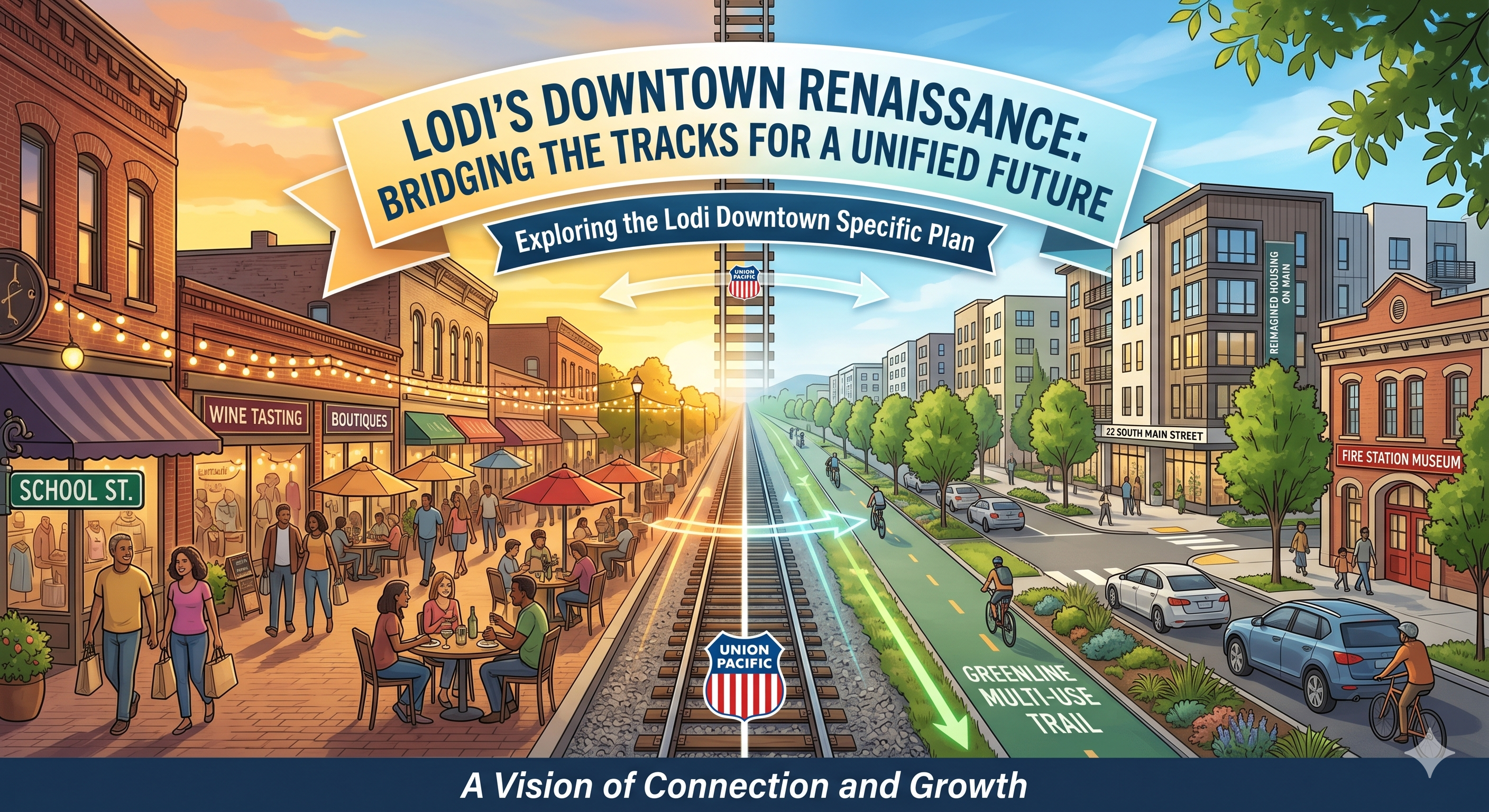
If you spend a Sunday afternoon in downtown Lodi, you will likely find yourself strolling down a vibrant School Street, popping into bustling boutiques, or enjoying a glass of wine at a local tasting room. But if you walk just a few blocks east, the energy suddenly stops. The Union Pacific Railroad tracks serve as an iron divide, separating the thriving west side from an east side that has historically struggled with disinvestment, vacant parcels, and safety concerns.
How does a city bridge such a stark physical and economic divide? Enter the Lodi Downtown Specific Plan (DTSP). Designed as a comprehensive 10-to-20-year regulatory framework, this ambitious blueprint aims to transform the city's historic core into a walkable, high-density, mixed-use destination. It is not just about beautification; it is a strategic effort to generate economic vitality and housing opportunities that benefit the entire community.
"Reconnecting both sides of the rail corridor offers Lodi the chance to unite its downtown, transforming a long-standing divide into a shared space for growth, connection, and community pride."
Here is a deep dive into how the DTSP plans to reshape downtown Lodi over the next several years, with a special look at the long-awaited eastward expansion.
The Eastside: An Untapped Canvas
For decades, the area east of the railroad tracks has been an afterthought, but the DTSP envisions it as an "untapped canvas ready to be transformed into a vibrant extension of the downtown". The plan calls for high-density, mixed-use infill development to bring new residential life to these underutilized blocks. A major cornerstone of this effort is the "Reimagined Housing on Main" facility at 22 South Main Street, a $1.34 million supportive housing project designed to anchor residential redevelopment on the east side.
By injecting housing into the area, the city hopes to generate the necessary foot traffic to support new ground-floor retail shops and restaurants. This is a fascinating shift in urban planning for Lodi—moving away from outward sprawl and leaning heavily into transit-oriented development to breathe 24/7 life into forgotten neighborhoods.
A Main Street Makeover
To support this new Eastside energy, the Main Street corridor itself will undergo a massive transformation. The city plans to negotiate with Union Pacific to acquire enough adjacent railway property to establish a consistent 80-foot right-of-way from Elm Street to Walnut Street.
This expanded space will allow for a complete streetscape overhaul. Imagine wide sidewalks, parallel parking, decorative paving, and drought-tolerant landscaping celebrating the area's multicultural heritage. It will change Main Street from a desolate industrial edge into a welcoming thoroughfare that invites people to linger, shop, and socialize.
The Greenline and Community Landmarks
Beyond housing and roads, the east side will see significant investments in public gathering spaces and green infrastructure. The DTSP highlights catalytic projects like the restoration of the historic Fire Station Museum and pedestrian promenades linking directly to a newly renovated Hale Park.
One of the most exciting mobility improvements is the proposed off-street multi-use trail. This climate-resilient greenway, shaded by a continuous native tree canopy, will extend from Lodi Avenue on the south all the way to the Softball Complex on the north. By offering a safe, protected route for cyclists and pedestrians, Lodi is taking a massive step toward becoming a truly modern, low-carbon city that prioritizes active transportation.
Overcoming the Iron Barrier
None of these Eastside improvements will matter if residents cannot safely and pleasantly cross the railroad tracks. The physical barrier is compounded by the noise and pollution of freight trains.
To combat this, the plan heavily explores the implementation of a "quiet zone". By adding enhanced crossing safety features, trains would be able to pass through the downtown corridor without blasting their horns, instantly making the adjacent east side neighborhoods more livable and attractive to private investors. It is a brilliant administrative move that solves an infrastructure problem while simultaneously boosting real estate viability.
Polishing the Westside Jewel
While the Eastside is getting a complete reimagining, the already-successful Westside is getting a refined polish. The plan focuses on preserving the historic character that makes School Street a regional draw.
We can expect to see expanded outdoor dining, permanent parklets, and year-round "twinkle" lighting to keep the streets safe and inviting after dark. The plan also introduces creative traffic-calming measures, such as a "road diet" on Lockeford Street, converting Locust Street into a bicycle boulevard, and closing a portion of Sacramento Street to create a pedestrian plaza that ties directly into the World of Wonders Science Museum expansion.
Looking Forward
The Lodi Downtown Specific Plan represents a bold, unified vision for the future. By intentionally directing resources across the railroad tracks, Lodi is choosing to heal a historic divide and create a cohesive, vibrant urban core that works for everyone. The blueprint is drawn, and the regulatory groundwork is being laid, but the true test will be in the execution and securing of funding over the next decade.
As Lodi prepares to step into this new era of urban revitalization, one has to wonder: When the barriers finally fall and the tracks are bridged, what will be your first stop in the newly unified Downtown Lodi?
Authored by Lacey Cordero.
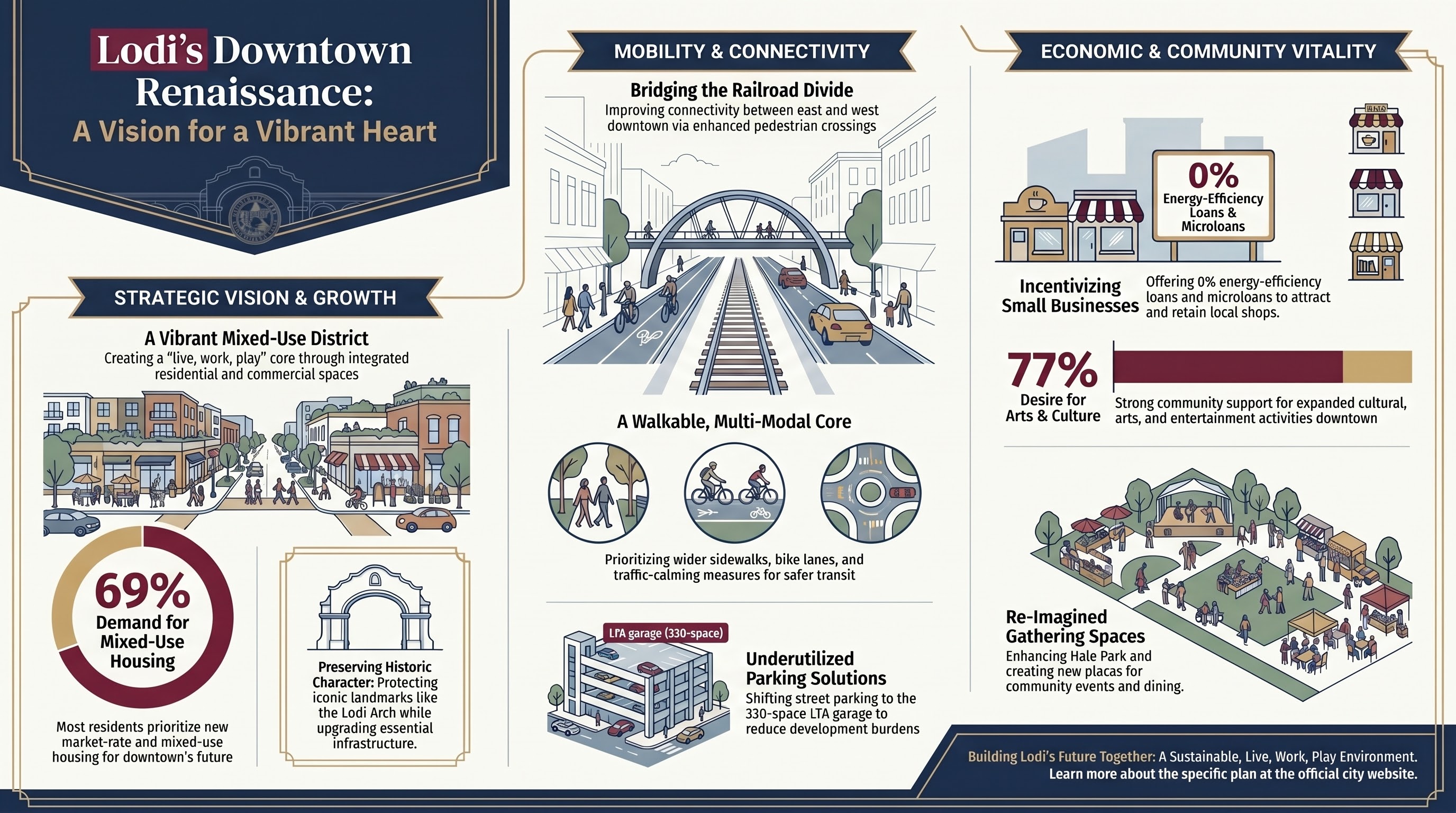
Here is the list of the sources used to compile the information for this blog post.
"01.30.26 Lodi Specific-Plan-Public Review_USE THIS.pdf": This was the primary source for the vision of the Downtown Specific Plan. It provided the exact quote describing the Eastside as an "untapped canvas", detailed the goal to negotiate an 80-foot right-of-way on Main Street, and outlined the proposed climate-resilient multi-use trail extending from Lodi Avenue to the Softball Complex. It also detailed the "Westside polish," including the addition of twinkle lighting, the Lockeford Street "road diet," and the Locust Street bicycle boulevard.
"Strategic Blueprint for Urban Revitalization: A Comprehensive Policy Analysis of the Adopted Lodi Downtown Specific Plan": This source provided the specific details regarding the "Reimagined Housing on Main" facility at 22 South Main Street, identifying it as a $1.34 million supportive housing project intended to anchor residential redevelopment on the east side.
"Lodi City Council Agenda - May 20, 2026": This source corroborated the financial details and completion of the $1.34 million Reimagined Housing on Main (Phase 2) project.
"Lodi City Council Agenda - June 3, 2026": This agenda detailed the "Discovery Plaza" project, which involves closing a portion of Sacramento Street to create a pedestrian plaza tied to the World of Wonders (WOW) Science Museum expansion.
"01.30.26 Lodi Specific-Plan- APPENDIX_REDUCED.pdf": This document provided the technical background on the proposed traffic-calming measures (like the Lockeford Street Road Diet) and the foundational feasibility evaluation for the implementation of a railroad "Quiet Zone".

Brian Halstead
| The Halstead Team | Konrad RE | PLACE
or another way