
Categories
Helpful Tips, Lodi NeighborhoodsPublished April 14, 2026
The Lodi Paradox

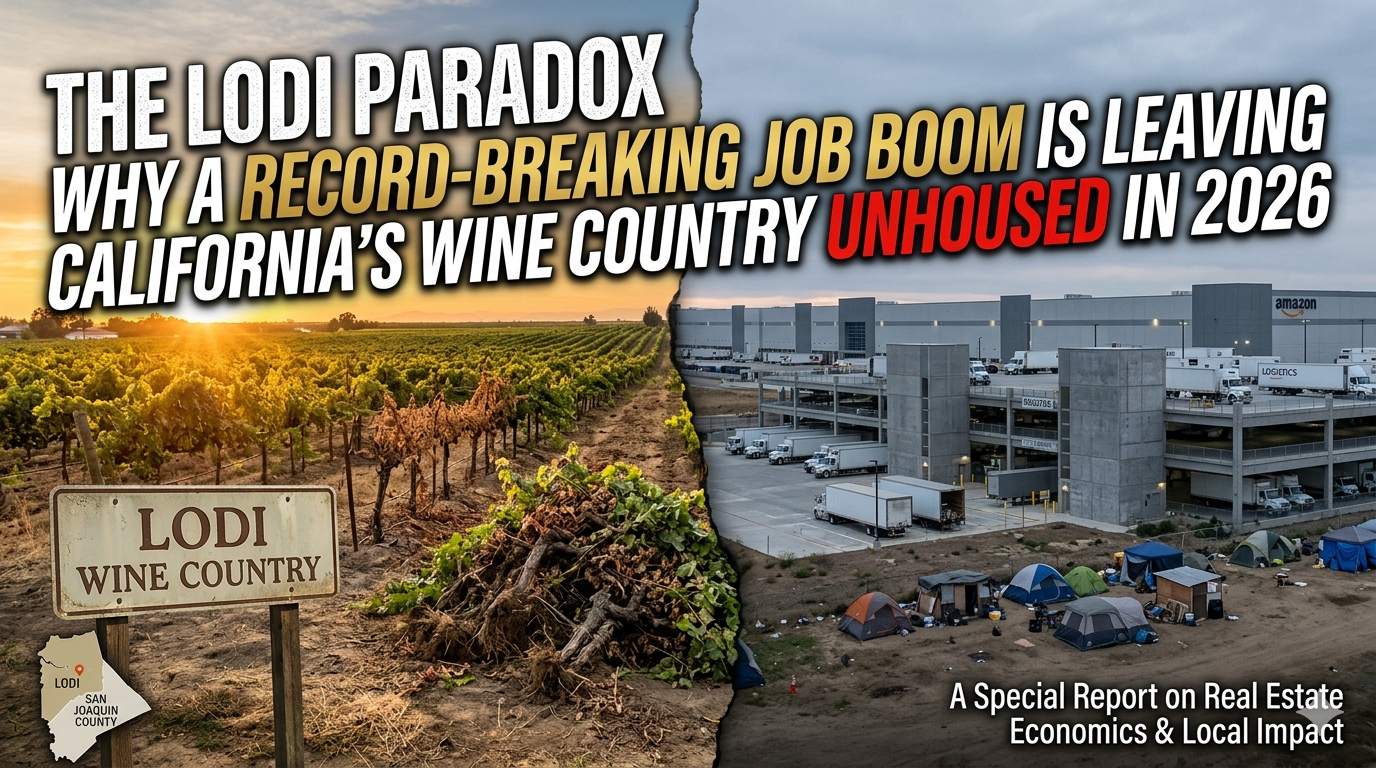
The Lodi Paradox: Why a Record-Breaking Job Boom is Leaving California’s Wine Country Unhoused in 2026
Driving through the outskirts of Lodi in the spring of 2026, the visual cues of a city in transition are unavoidable. On one side of the road, the 🍇 "Zinfandel Capital of the World" is showing its age; piles of uprooted grapevines sit in dry heaps awaiting disposal—the skeletal remains of an industry battered by declining national consumption and the worst 🍒 cherry crop in decades. On the other side, the horizon is dominated by the monolithic grey walls of new logistics hubs, where the hum of 24-hour commerce signals a new economic era.
Lodi has reached a pivotal inflection point. As we navigate 2026, the city is caught in a jarring juxtaposition: it is the epicenter of a regional employment boom, leading the state in job growth, yet it is simultaneously grappling with a homelessness crisis of emergency proportions. The very forces intended to modernize the city’s economy are, paradoxically, tightening the noose on its most vulnerable residents.
For those of us tracking the intersection of municipal planning and real estate economics, Lodi is no longer just a weekend wine destination. It is a laboratory for what happens when 🚛 global logistics capital meets a historic agricultural hub that hasn’t built enough housing to keep up with its own success.
🏡 The Housing Paradox: Prices are Dipping, but the Door is Still Locked 📉
On paper, the real estate market is "cooling." Median home prices in San Joaquin County have undergone a 4.3% year-over-year correction, resting at roughly 503,000 (589,000 in Lodi proper). But for the local workforce, this "dip" is an illusion of affordability. The door to homeownership remains locked by a staggering supply deficit: only 1,225 homes are currently under construction across the Stockton-Lodi metropolitan area against a projected demand of 10,100 units.
The rental market offers no relief. As of March 2026, the average rent in Lodi has climbed to $1,938, with a razor-thin vacancy rate of 3.6%. This is particularly devastating for the 44% of renter households that include children. The structural vulnerability is most acute among extremely low-income households, 81% of whom now spend more than half their income on housing.
"San Joaquin County and the City of Lodi are at a pivotal inflection point," notes the Emerging Trends 2026 report. "A homelessness crisis of historic scale is colliding with a paradoxical employment boom... creating a two-speed economy that leaves many workers in low-wage jobs with insufficient income to afford local housing."
The "Two-Speed" Economy: Logistics Booms while the Vineyards Fade
Lodi’s economy is currently a tale of two sectors moving in opposite directions. The region leads California with a 5.5% annual job growth rate, driven almost entirely by the explosive expansion of logistics. Amazon alone now employs over 13,000 workers in the region, and transportation and warehousing account for nearly 20% of all regional employment.
However, this boom is not a silver bullet. While logistics jobs offer entry-level wages between $16 and $22 an hour, they fail to bridge the affordability gap for the $589,000 median home. This has created a "persistent mismatch" where the jobs being created do not provide the wages required to survive the very market they are fueling. Meanwhile, the agricultural soul of Lodi is under acute stress. Between commodity shocks, the impact of avian flu on food prices, and a "culture of fear" surrounding immigration enforcement, the agricultural workforce is fragmenting. This explains the irony of Lodi’s 6.4% unemployment rate—nearly a full point higher than the state average—despite the hiring spree at nearby fulfillment centers.
The Investor Incursion: Why Your Next Neighbor Might be a Corporation
The struggle for local families to secure a foothold is further complicated by "Price Arbitrage." Real estate investors accounted for 26.8% of U.S. residential sales in early 2025, and they have identified San Joaquin County as a prime target. Why? Because prices here are approximately 56% lower than the Bay Area, yet proximity via the I-5 corridor sustains high rental demand.
MetLife Investment Management projects that institutional investors could control 40% of U.S. single-family rental homes by 2030. In Lodi, this creates an "Affordability Spiral" where cash-rich corporations outcompete local buyers sidelined by 6.9% mortgage rates.
The Corporate Impact on Local Real Estate:
- Price Pressure: Investor demand increases the price-to-income ratio, particularly in the entry-level "bottom tier."
- Supply Constriction: By converting potential owner-occupied homes into permanent rentals, investors reduce the inventory available for families to build equity.
- Decoupling: Home prices increasingly reflect global capital flows rather than the actual earning power of Lodi’s residents.
The Homelessness Emergency: A 104% Surge
The human cost of this economic decoupling is visible in the 2024 Point-in-Time (PIT) count. San Joaquin County saw a staggering 104% increase in homelessness since 2022, totaling 4,732 individuals. In Lodi, 416 people are experiencing homelessness, and 63% are unsheltered—living in vehicles, encampments, or on the streets.
"San Joaquin County's homelessness crisis has reached emergency proportions," the report continues, noting that the unsheltered population countywide surged 156% in just two years.
The economic pipeline into homelessness ⛺ is clear: when 81% of the lowest-income earners are one missed paycheck away from losing their housing, the transition from the "two-speed economy" to the street is often a single event—a medical bill, a car repair, or a failed cherry harvest.
The 2026 Blueprint: 500 Units and a State-of-the-Art Shelter
Lodi is attempting to build its way out of this crisis. There are currently more than 500 new housing units in the pipeline, representing a shift toward higher density and targeted needs:
- Market-Rate Mixed Use: The 12 West Apartments on the Kettleman Lane corridor are bringing 210 resort-style units to the market, while the Lodi Lakehouse project (currently under environmental review) proposes 150 apartments alongside a 92-room boutique hotel and 18,000 square feet of retail.
- Senior & Affordable Housing: Sunset Homes will transform the historic Sunset Theater site into 44 senior condos. Meanwhile, a project on Century Boulevard (formerly referred to as Lodi Commons) is planned to provide 110 affordable units for seniors and veterans, though it has not yet broken ground and may face a name change to avoid confusion with existing facilities.
- Civic Infrastructure: The city is nearing completion of a $13 million state-of-the-art animal shelter 🐕 on Auto Center Drive, replacing a 1958 facility, and the permanent Lodi Access Center and Emergency Shelter is slated to open in Spring 2026, offering wraparound mental health and job readiness services.
The Future of the Map: Annexation and Expansion
Lodi’s long-term strategy relies on expanding its footprint. The city is eyeing "South" and "West" Study Areas for annexation, with the potential to add 2,000+ units.
However, as any strategist will tell you, a line on a map is not a home. The West Study Area is expected to move first because infrastructure is largely already planned or in place. In contrast, the South Study Area faces significant hurdles, including the need for two new electric utility substations and complex storm water connections. To bridge this gap, the city’s Housing Element aims to secure $8 to $10 million for infrastructure expansion—a necessary prerequisite for the "missing middle" housing the city's logistics workforce desperately requires.
A Provocative Glimpse Ahead
As we look at the Lodi of 2026, the volume of investment is unprecedented. Between luxury "resort-style" apartments and state-of-the-art service centers, the city is working to reinvent itself. Yet, the question remains: can these initiatives reverse a trend that saw homelessness double in four years?
New apartments and shelters are essential, but they also highlight the growing rift between the city’s agricultural heritage and its industrial future. Can Lodi maintain its agricultural soul—the very thing that makes it a destination—while evolving into a high-density logistics and residential hub? The answer will be found in whether the people who work in the warehouses and the surviving vineyards can actually afford to live in the city they are building.

Brian Halstead
| The Halstead Team | Konrad RE | PLACE
or another way